

The 2026 CGO: Why Brand Building is No Longer Enough
By Kenny Young |
In the traditional CPG model, companies grew through creative stories and massive retail reach. However, the industry has radically re-engineered the “Growth” function for 2026. For middle-market companies—especially those with Private Equity backing—the era of the siloed CMO has ended. Today, firms require a “Revenue Architect” to navigate a fragmented marketplace. Enter the Chief Growth…
Read More 
Why Your Next COO Needs to Build Networks, Not Just Chains
By Kenny Young |
The traditional “Supply Chain” is a 20th-century concept. It implies a linear, rigid progression from raw material to end consumer. But in 2026, volatility is the only constant. Whether it’s geopolitical shifts or sudden algorithmic spikes in demand, the “linear” model is too slow to react. To thrive, middle-market CPG companies must transition to “Sense-and-Respond” Networks. This…
Read More 
The Rise of the Fractional “AI Operating Partner”: Closing the 2026 Tech Gap
By Kenny Young |
In the traditional Private Equity playbook, “Value Creation” was often synonymous with cost-cutting, supply chain rationalization, and standardizing financial reporting. But as we enter the second half of 2026, the lever for driving multiples has shifted toward a new, high-stakes capability: AI Orchestration. For middle-market CPG firms, the challenge is binary. You either leverage AI to…
Read More 
CPG Leadership 2026: Why Digital Fluency Outpaces Experience
By Kenny Young |
For decades, the “Gold Standard” for a CPG executive hire was simple: 20+ years at a Tier-1 multinational and a deep Rolodex of retail buyers. But as we move through 2026, experience —once the ultimate hedge against risk—is becoming a lagging indicator. In a world of AI-driven supply chains and algorithmic consumer behavior, “having done…
Read More 
Executive Search for Mid-Market CPG: Solving the 2026 Productivity Gap
By Kenny Young |
In April 2026, the CPG landscape has reached a “K-shaped” inflection point. While the industry contributes $2.5 trillion to U.S. GDP, investors have shifted their mandate: Growth is decoupling from simple hiring. Success now requires radically increased productivity through AI and digital transformation. For mid-market companies ($50M–$1B), the challenge isn’t just “filling a role”—it’s finding…
Read More 
CPG Middle-Market Resilience Strategies
By Kenny Young |
Strategic middle-market CPG resilience is now the primary driver for 2026 growth. Consequently, firms are pivoting from simple price hikes to volume-led efficiency. To illustrate, recent data suggests that digital leaders often achieve significantly higher shareholder returns. Furthermore, Private Equity (PE) sponsors now prioritize “Complexity Arbitrage” over traditional roll-ups. How do resilience strategies solve “K-shaped”…
Read More 
What Changed in CPG Growth Strategy—and Why It Matters Now
By Kenny Young |
The short answer: CPG growth is shifting away from internal innovation to acquisition-led scaling, powered by private equity and changing consumer behavior. For decades, CPG companies built brands internally through R&D, marketing, and sales engines. Today, growth increasingly comes from acquiring emerging brands that already resonate with niche audiences. It’s faster, less risky, and more…
Read More 
How the CPG Landscape Has Evolved Over 35 Years
By Kenny Young |
Introduction: What Changed—and Why It Matters The CPG landscape looks nothing like it did 35 years ago—and that’s not just nostalgia talking. From analog “brick phones” to AI-powered supply chains, the industry has undergone a fundamental rewiring. The short answer: The CPG landscape has evolved over 35 years from relationship-driven, manual operations to a digitally…
Read More 
3 Reasons Post-Acquisition Integration Succeeds in Middle-Market CPG
By Kenny Young |
There’s a popular narrative around post-acquisition integration in middle-market CPG that often makes the rounds. You know the one, it goes something like this: “Integration is messy.”“Cultures clash.”“Strategies stall.” Sometimes, that’s spot on. But after observing a fair share of middle-market CPG companies navigating private equity transitions, I’ve noticed a different trend. When integration works…
Read More 
How Operating Teams Win the First 180 Days After a PE Deal
By Kenny Young |
The first 180 days after private equity investment are won not by strategy but by leadership execution discipline — clarity of roles, KPI ownership, and decision velocity. Nothing tests an operating company faster than this early stretch. Everyone feels the pressure: the board wants traction, finance expects clean reporting, commercial needs alignment, and supply chain…
Read More 
The PE-Grade CPG CFO: Built for Exit Value
By Kenny Young |
The modern private equity-backed Consumer Goods CFO is no longer a scorekeeper — they are the architect of EBITDA expansion, cash optimization, and exit multiple acceleration. That’s the short answer. If your CFO is only closing the books and managing audits, you don’t have a PE-grade finance leader. You have an accounting department. Today’s portfolio…
Read More 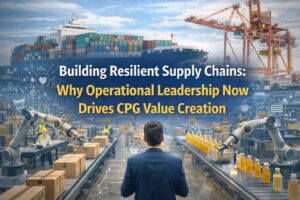
Building Resilient Supply Chains: Why Operational Leadership Now Drives CPG Value Creation
By Kenny Young |
For years, supply chain leadership in CPG was expected to do one thing exceptionally well: Stay out of the way. If product showed up on time, costs behaved, and retailers weren’t calling with complaints, operations was considered “solid.” Strategy happened elsewhere. As noted in Bain’s 2025 Consumer Products Report highlighting the impact geopolitical, regulatory, and…
Read More 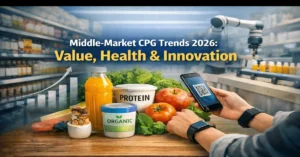
Middle-Market CPG Trends 2026: Value, Health & Innovation
By Kenny Young |
Middle-Market CPG Trends 2026: What’s Driving Growth? The middle-market CPG industry isn’t slowing — it’s recalibrating. Shoppers are hunting for value, flirting with health-focused products, and quietly ghosting brands that raised prices one too many times. Here’s the short answer: Consumers now expect premium quality and affordability — and the brands that balance both will…
Read More 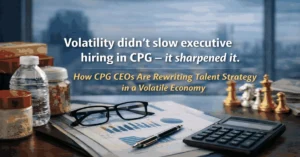
How CPG CEOs Are Reshaping Talent Strategy in Todays Volatile Economy
By Kenny Young |
For much of the past decade, growth covered a multitude of sins in consumer-packaged goods. Rising demand masked inefficient networks. Cheap capital forgave bloated cost structures. Pricing power arrived often enough to paper over operational cracks. Leadership teams were built to scale, sometimes before they were built to endure. That environment changed quickly. Over the…
Read More 
How Private Equity Talent Strategy Is Driving Value Creation in Middle-Market CPG
By Kenny Young |
In middle-market CPG, value creation is no longer driven solely by brand extensions, pricing actions, or operational efficiencies. Increasingly, private equity talent strategy has become the decisive lever shaping investment thesis, operating plans, and exit outcomes. This shift reflects a broader recognition that leadership quality—not just capital structure—determines how much value can be unlocked during…
Read More